Why Maintenance Windows Matter in Web Hosting More Than Most Website Owners Think
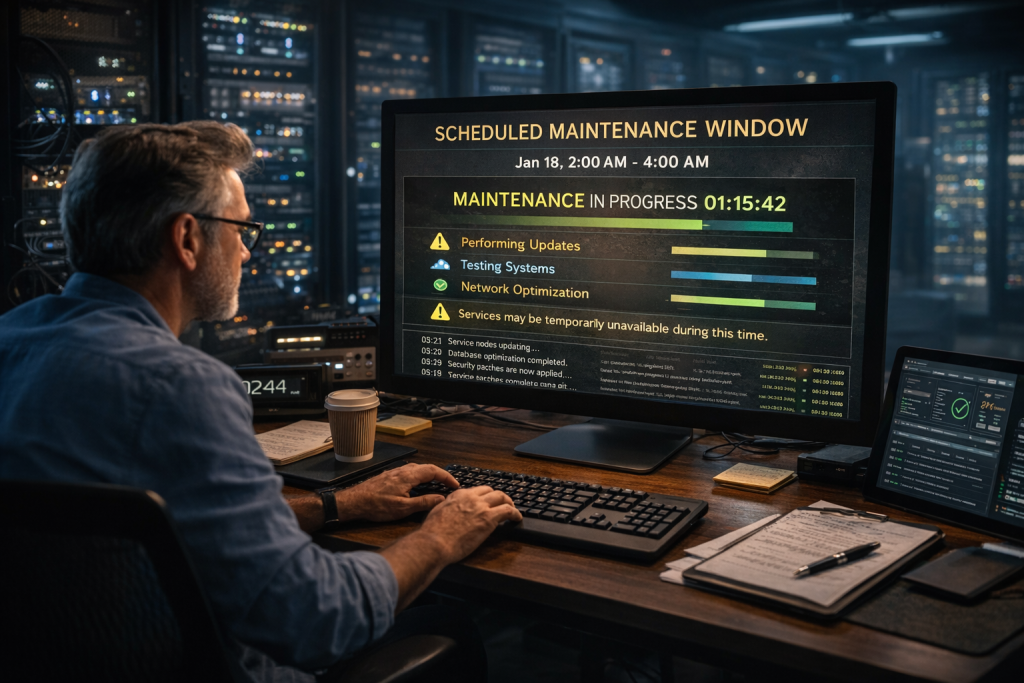
Web hosting is usually talked about in terms of permanent availability. Providers promise stability, responsiveness, reliability, and around-the-clock service. Customers expect websites to be accessible at any moment, and for good reason. The web feels continuous. A business site, an online store, a booking platform, or a customer portal is not supposed to close for the evening like a physical office.
Yet behind that appearance of continuity lies a less glamorous truth: healthy hosting depends on interruption being managed well.
This is where maintenance windows enter the picture. They are one of the least discussed but most revealing aspects of web hosting. A maintenance window is not simply a period when a system is taken offline. In its best form, it is a controlled slice of time in which necessary change can happen with minimal confusion, minimal risk, and clear expectations. It is a discipline, not just a delay. And the way a hosting environment handles that discipline says a great deal about its maturity.
Many website owners do not think about maintenance windows until they are forced to. A platform update happens at an awkward hour. A panel becomes temporarily unavailable. A site behaves oddly after an infrastructure change. A plugin update collides with a server adjustment. A database task runs longer than expected. A DNS-related transition causes partial inconsistency. Suddenly the abstract idea of “ongoing service” collides with the practical reality that systems need care.
Web hosting is not only about keeping websites online. It is also about knowing how to introduce change without creating disorder.
Continuous service still requires planned disruption
There is a natural tendency to think of good hosting as something close to untouched perfection. The server runs, the site loads, the account dashboard works, and the customer does not have to think about the machinery underneath. In one sense, that is exactly the point. Hosting should not make ordinary use harder than it needs to be.
But no serious technical environment remains healthy without maintenance. Security patches must be applied. software versions must be advanced. Hardware must sometimes be replaced or rebalanced. Certificates need renewal. control panels evolve. databases need optimization. file systems may need attention. monitoring agents change. virtualization layers improve. network paths are adjusted. scheduled jobs are refined. backup systems are tested and modernized.
In other words, reliability is not the absence of change. It is the result of change being handled properly.
That is why maintenance windows matter. They create a boundary around change. They acknowledge that work on infrastructure has consequences and that those consequences should be shaped rather than left to chance. Without that boundary, updates can happen opportunistically, unpredictably, or under pressure. That may sound flexible, but in practice it often creates more instability, not less.
A hosting provider that respects maintenance as a formal operational activity usually understands something important: unmanaged continuity is fragile continuity.
The real issue is not downtime, but uncertainty
Website owners often react strongly to the idea of scheduled maintenance because it sounds like permission for downtime. But the bigger problem in most web operations is not interruption alone. It is uncertainty.
A short, announced period of limited availability is often easier to live with than vague instability. If users know a change is happening, they can plan around it. Teams can delay publishing actions. marketing staff can avoid scheduling campaigns at the wrong moment. store owners can pause updates. administrators can avoid making live changes mid-transition. Expectations are aligned.
The real damage tends to come when change is happening but nobody understands that it is happening. A site becomes intermittently strange. login sessions behave unpredictably. content edits fail once and work on retry. dashboards lag. scheduled tasks skip a run. images upload in one browser but not another. Nothing looks fully broken, yet nothing feels trustworthy either.
That kind of ambiguity is costly. It wastes time because teams cannot tell whether they are facing a local mistake, a software conflict, user error, or platform-level maintenance side effects. Hosting quality shows itself not just in how rarely disruption occurs, but in whether disruption is visible, bounded, and intelligible when it does occur.
A proper maintenance window reduces guesswork. It turns hidden change into acknowledged change.
Hosting maturity is visible in how change is scheduled
Not every hosting provider treats maintenance with the same seriousness. Some approach it as an operational craft. Others seem to treat it as an unavoidable nuisance. The difference affects customers more than many realize.
A mature host tends to think about timing, scope, communication, and user impact together. It does not merely ask, “When can we do this work?” It asks, “When can we do this work in a way that causes the least confusion, least business disruption, and clearest recovery path?”
That kind of thinking recognizes that hosting customers are not identical. A maintenance window that seems harmless from the provider’s perspective may collide with a customer’s product launch, ad campaign, event registration period, or international traffic cycle. Hosting environments serve users across time zones, business models, and operating patterns. The more a provider understands this, the more thoughtful its maintenance discipline tends to become.
By contrast, a provider that handles maintenance casually often reveals a narrow internal view. Changes may technically complete, but the customer experience feels secondary. Notices arrive late. Explanations are vague. status information is thin. The work may be defensible in engineering terms while still feeling clumsy in service terms.
This matters because hosting is not only infrastructure management. It is infrastructure management in relationship with businesses, creators, teams, and customers who depend on consistency.
Maintenance windows protect against rushed decision-making
One of the biggest practical benefits of formal maintenance windows is that they reduce the temptation to make hurried changes in messy conditions.
Technical systems often get into trouble not because a change was inherently bad, but because it was made at the wrong moment, under the wrong pressure, without enough room to observe the consequences. Something small appears urgent, gets pushed through quickly, and then turns out to interact badly with something else. A chain of reactive edits follows. The platform becomes less stable not because change occurred, but because change occurred without proper containment.
A maintenance window is a form of containment.
It creates a moment where change can be introduced deliberately. Teams can prepare. dependencies can be considered. rollback paths can be thought through. monitoring can be watched more carefully. customer-facing communication can be aligned. The work becomes less improvisational.
This is valuable even for smaller websites. In fact, small businesses may benefit from it especially, because they often lack the redundancy of larger organizations. If a change goes wrong at the wrong time, there may be no internal technical team standing by to absorb the impact. A disciplined hosting provider lowers the chance that ordinary customers are forced into emergency mode.
Planned maintenance influences trust
Trust in hosting is often imagined as a result of strong infrastructure alone. But trust also depends on how a provider behaves when it needs to touch that infrastructure.
Customers do not necessarily lose faith because maintenance exists. Most understand, at least in principle, that systems need updates. What damages trust is carelessness, opacity, or surprise.
When a provider communicates clearly, scopes the maintenance honestly, and behaves predictably during the event, users feel that the environment is being actively managed. Even inconvenience feels easier to accept when it is clearly part of competent stewardship. The provider appears to be in control of its own platform.
When communication is thin or confusing, the same maintenance can feel alarming. Customers start wondering what else is happening behind the scenes. They begin to interpret minor issues as evidence of deeper disorder. A single unclear maintenance event can plant long-term doubt, especially for people running revenue-generating websites.
In this sense, maintenance windows are not just technical logistics. They are moments of relationship management. They show whether a host treats operational change as part of customer trust or as something customers are simply expected to endure.
Different websites experience maintenance differently
One reason maintenance is often underestimated is that website owners imagine it in generic terms. But the impact of a maintenance window depends heavily on the type of site involved.
A portfolio site may barely notice a short planned interruption. A blog may be inconvenienced but not materially harmed. A membership platform, e-commerce store, booking system, education portal, or SaaS dashboard may feel the same interruption much more sharply. A change that touches authentication, databases, uploads, email routing, or scheduled processes can matter differently depending on what the site actually does.
That means hosting providers who truly understand maintenance do not think only in server terms. They think in usage terms. They recognize that “availability” is not experienced uniformly. A five-minute service wobble during a low-traffic content period is different from the same wobble during a payment-heavy retail campaign or a registration deadline.
This is another reason maintenance windows deserve more attention in hosting conversations. They are one of the places where generic infrastructure promises meet the messy diversity of real-world websites.
Maintenance windows are part of change management, not just server work
A useful way to understand this topic is to see maintenance windows as part of change management. That phrase may sound corporate, but the idea is simple: any technical environment that changes over time needs a disciplined way to introduce those changes.
Web hosting often gets marketed as though the hard part ends once the site is launched. In reality, launch is only the beginning of a long sequence of changes. Operating systems age. panel software evolves. PHP versions shift. security assumptions change. account structures are adjusted. integrations are added. storage patterns expand. sites become heavier, busier, or more interconnected.
Without change management, a hosting environment becomes brittle. It may still look stable on normal days, but every non-routine action becomes more hazardous than it should be.
Maintenance windows are one of the visible surfaces of that deeper discipline. They indicate that the provider recognizes change as an operational event worthy of planning, sequencing, and communication. They show that the host is not simply reacting to issues, but shaping the lifecycle of the platform intentionally.
There is a difference between frequent maintenance and disruptive maintenance
Some customers assume that more maintenance notices automatically mean a worse provider. That is not necessarily true. In some cases, visible maintenance is evidence that the environment is being actively looked after. What matters more is whether that maintenance is organized well.
A host can perform regular work with minimal disruption if its processes are mature. Another can rarely announce maintenance yet still expose customers to scattered instability because changes are happening in less structured ways. Frequency alone does not tell the story.
The more useful question is whether maintenance feels controlled. Are interruptions brief relative to the scope of work? Are customers warned appropriately? Does the provider describe likely effects honestly? Is there a dependable pattern to how maintenance is conducted? Are post-change conditions stable?
A hosting service should not be judged only by whether it ever needs maintenance. Any serious platform will. It should be judged by whether maintenance feels like evidence of professionalism or evidence of fragility.
Website owners should think operationally too
Although much of the responsibility lies with the provider, customers also benefit from thinking more consciously about maintenance. Too many site owners treat their websites as if they exist outside operational time. They assume that once a site is live, any moment is equally suitable for updates, design edits, plugin changes, third-party integrations, or content restructuring.
In reality, websites have rhythms. They have busier hours, quieter hours, campaign periods, seasonal spikes, and operational sensitivities. When customers understand that, they are better positioned to work with hosting maintenance rather than be blindsided by it.
This does not mean site owners need to become infrastructure planners. It simply means recognizing that websites are living systems. They benefit from intentional timing. Publishing changes, upgrading components, or reconfiguring services during known maintenance periods or around announced windows is often smarter than acting randomly and hoping nothing overlaps.
The more a customer sees hosting as an operational environment rather than a static product, the more value they tend to get from it.
Good hosting is not motionless hosting
Perhaps the most important thing maintenance windows reveal is this: good hosting is not motionless hosting.
A healthy platform moves. It gets updated, corrected, refined, secured, and improved. The goal is not to freeze it in place. The goal is to keep it evolving without making customers feel exposed to constant turbulence. That balance is harder than it sounds, and it is one of the clearest markers of hosting competence.
Maintenance windows are part of how that balance is achieved. They are the visible acknowledgement that stability is maintained through care, not through neglect. They create room for necessary work without pretending that websites and servers are immune to time.
For website owners, that perspective is useful because it shifts the question. Instead of asking only whether a host promises uninterrupted service, it becomes worth asking how that host handles the moments when interruption, adjustment, or system change is unavoidable. That is often where the true quality of the platform appears.
A web host can look impressive when everything is quiet. It proves more about itself when it needs to change something and still keep the customer experience coherent. In the long life of a website, those moments matter more than most people realize.